
A couples therapy treatment plan has to do something an individual plan does not: hold two people’s experiences at the same time without turning the plan into a list of what one partner needs the other to change.
Both partners may describe the same problem differently. They may want different things from therapy. One may be focused on communication, while the other is worried about trust, intimacy, parenting, or whether the relationship can continue at all.
A useful couples treatment plan gives that complexity a structure. It identifies the relationship patterns that bring the couple to therapy, turns broad concerns into workable goals, connects those goals to specific interventions, and gives you a way to notice whether anything is actually changing.
This guide walks through the main parts of a couples counseling treatment plan, sample goals and objectives for communication, conflict, emotional connection, and trust, a complete treatment plan example, and practical ways to track progress.
If creating the structure itself is the part that takes too much time, the Couples Therapy Documentation Toolkit includes a customizable Google Sheets treatment plan builder along with intake, session, and progress-note tools. I’ll show where that can fit into the workflow later in the article.
Before writing goals, clarify what the treatment is addressing
Do not start by filling in goals simply because the treatment-plan form has empty boxes.
First clarify the focus of the work.
In some practices, couples counseling is primarily relationship-focused: the couple is seeking help with communication, conflict, trust, intimacy, parenting, decision-making, or another relational concern.
In other situations, a partner may be receiving treatment for an individual clinical condition while couple or family sessions are used because the relationship context is relevant to that treatment.
If insurance, an agency, or another third party is involved, follow the documentation and medical-necessity requirements that apply to that service. Requirements are not identical across payers, employers, or jurisdictions.
A simple question before you begin can prevent a great deal of confusion later:
What exactly is this treatment plan trying to change?
What should be included in a couples therapy treatment plan?
The exact format will depend on your setting, but most useful couples treatment plans need to answer six basic questions.
| Part | What the reader should understand |
|---|---|
| 1. Presenting concerns | Why the couple is seeking therapy now, including each partner’s perspective and the recurring relationship pattern you are seeing. |
| 2. Assessment and context | Relevant relationship history, strengths, stressors, individual factors, previous attempts to solve the problem, and other information that affects treatment. |
| 3. Safety considerations | Whether there are concerns that affect the appropriateness or structure of conjoint treatment. |
| 4. Treatment goals | The broader changes the couple hopes to make. |
| 5. Objectives and interventions | What progress will look like in practice and what you plan to do therapeutically to support it. |
| 6. Progress and review | How you will notice change, review the plan, and decide whether goals should continue, change, or be completed. |
Assessment: what to understand before choosing couples therapy goals
The strongest goals usually come from understanding the pattern before trying to fix it.
Useful areas to explore may include:
- Each partner’s description of the problem. Where do their accounts overlap, and where are they different?
- The recurring cycle. What tends to happen before, during, and after a difficult interaction?
- Triggers and vulnerabilities. What makes the cycle more likely to begin or escalate?
- Strengths. What still works between them? When do they communicate, cooperate, repair, or support each other successfully?
- Relationship history. Important transitions, losses, betrayals, changes in roles, parenting demands, health issues, financial stress, or other relevant events.
- Individual factors. Mental health concerns, trauma history, substance use, health problems, neurodivergence, or other factors that may affect the relationship and treatment.
- Expectations for therapy. Do both partners want the same thing from treatment?
- Commitment and uncertainty. Is one partner unsure about remaining in the relationship? If so, that may need to be clarified before assuming that reconciliation is the shared goal.
- Previous solutions. What have they already tried, and what happened?
Assessment does not have to mean collecting an enormous amount of information before beginning treatment. It means gathering enough context to avoid writing goals that sound precise but do not actually fit the couple.
Safety belongs before communication skills
Communication exercises are not automatically the right starting point for every couple.
If there are concerns about intimate partner violence, threats, intimidation, coercive control, stalking, retaliation, or fear of what may happen after a session, the question is no longer simply, “Which communication skill should we teach?”
The safety and appropriateness of conjoint treatment need to be considered first, using the procedures, training, legal requirements, and professional standards that apply to your work.
Do not assume that every high-conflict relationship is abusive, but do not treat abuse as an ordinary communication problem either.
How to write couples therapy goals both partners can own
A useful couples goal usually describes a change in the relationship or interaction pattern rather than assigning one partner the job of fixing the problem.
Compare these:
| Instead of… | Try… |
|---|---|
| “Improve communication.” | “Partners will use agreed communication strategies during recurring disagreements and report fewer conversations ending in escalation or withdrawal.” |
| “He will stop being defensive.” | “Each partner will practice reflecting the other’s concern before explaining their own position during structured discussions.” |
| “She will stop criticizing.” | “Partners will practice expressing concerns as specific requests rather than global criticism during in-session discussions.” |
| “Stop fighting.” | “The couple will identify early signs of escalation and use an agreed pause-and-return strategy when needed.” |
| “Rebuild trust.” | “Partners will identify specific behaviors that increase or decrease felt safety and develop mutually agreed steps for rebuilding reliability and trust.” |
The second version in each example gives both partners a role and gives you something more useful to observe in therapy.
Broad goals are fine. Objectives make them usable.
“Improve communication” can be a perfectly reasonable treatment goal.
The problem comes when the plan stops there.
An objective turns the broad goal into something you can actually work on and revisit.
For example:
Goal: Improve communication during disagreements.
Possible objectives:
- Partners will identify the interaction pattern that typically leads to escalation.
- Each partner will demonstrate reflective listening during structured in-session conversations.
- The couple will practice a planned pause-and-return strategy during difficult conversations when escalation begins.
- Partners will report whether they were able to use the agreed strategy between sessions and what got in the way when they could not.
The objective does not always need a percentage or rigid numerical target. Use a measurable structure when it adds useful clinical information rather than forcing every relational goal into a number.
Sample couples therapy goals and objectives
The examples below are starting points, not scripts. Adapt the language, measurement, timeframe, and intervention to the couple, your clinical approach, and your documentation requirements.
Goal 1: Improve communication
Possible objectives:
- Each partner will practice summarizing the other partner’s perspective before responding during structured conversations in session.
- Partners will identify at least two communication habits that tend to make disagreements more difficult.
- The couple will practice one structured check-in between sessions and discuss what was helpful or difficult at the next appointment.
- Each partner will practice turning one recurring criticism into a specific request.
Possible interventions:
- Speaker-listener practice.
- Reflective listening and validation skills.
- Soft start-up coaching.
- Emotion identification.
- Reframing criticism as a request.
- Review of between-session conversations.
Goal 2: Reduce conflict escalation
Possible objectives:
- Partners will map the sequence of events that typically occurs during a recurring conflict.
- Each partner will identify personal signs that indicate escalation is beginning.
- The couple will develop an agreed pause-and-return plan for conversations that become unproductive.
- Partners will review a recent conflict and identify at least one point where the interaction could have taken a different direction.
Possible interventions:
- Negative-cycle mapping.
- Trigger and vulnerability identification.
- De-escalation planning.
- In-session conflict restructuring.
- Emotion-regulation strategies.
- Repair attempts and reconnection planning.
Goal 3: Strengthen emotional connection
Possible objectives:
- Each partner will practice expressing an underlying feeling, fear, or need rather than communicating only through complaint or withdrawal.
- Partners will identify situations in which they currently feel connected and explore what makes those moments different.
- The couple will establish a regular check-in focused on emotional experience rather than logistics alone.
- Partners will increase their ability to recognize and respond to bids for support or connection.
Possible interventions:
- Emotion-focused exploration.
- Attachment-focused interventions.
- Guided enactments.
- Validation practice.
- Appreciation and connection exercises.
- Exploration of attachment needs and protective responses.
Goal 4: Rebuild trust after a relationship breach
Trust work needs to be tailored carefully to what happened, the safety of the relationship, and what both partners have agreed to work toward.
Possible objectives:
- Partners will identify the specific behaviors or events that damaged trust and the current impact on the relationship.
- The hurt partner will identify what currently increases or decreases felt safety.
- The couple will agree on realistic, specific behaviors intended to increase reliability and transparency.
- Partners will review whether those agreements are helping and modify them when needed.
Possible interventions:
- Structured conversations about the breach.
- Accountability and repair work.
- Clarification of boundaries.
- Identification of triggers and reassurance needs.
- Rebuilding predictable routines.
- Exploration of meaning and impact rather than repeatedly litigating details.
Goal 5: Improve intimacy and affection
Possible objectives:
- Partners will identify emotional, relational, and practical barriers to closeness.
- Each partner will communicate preferences for affection and connection more directly.
- The couple will identify forms of connection that feel mutually comfortable and realistic at the current stage of treatment.
- Partners will discuss expectations around intimacy with less avoidance, criticism, or pressure.
Possible interventions:
- Exploration of intimacy expectations.
- Communication and boundary work.
- Attachment-focused interventions.
- Identification of contextual stressors affecting closeness.
- Gradual development of mutually agreed connection rituals.
Goal 6: Improve co-parenting
Possible objectives:
- Partners will identify the parenting disagreements that most frequently become relationship conflicts.
- The couple will distinguish parenting decisions from unresolved relationship grievances.
- Partners will develop a clearer process for discussing differences in rules, responsibilities, or discipline.
- The couple will identify areas in which they already work effectively as a parenting team.
Possible interventions:
- Co-parenting communication skills.
- Role clarification.
- Problem-solving practice.
- Identification of shared parenting values.
- Boundary work around conflict in front of children.
How the diagnosis fits when one partner is the identified client
When treatment is connected to one partner’s diagnosed condition, avoid writing a relationship plan that has no visible connection to that person’s clinical treatment.
Instead, show how the relational work relates to the symptoms, functioning, or treatment needs being addressed.
For example, instead of:
“Improve the couple’s relationship.”
you might document a treatment direction such as:
“Reduce the impact of depressive symptoms on relationship functioning by increasing supportive communication, reducing recurring conflict, and developing a shared plan for responding to periods of withdrawal.”
The partner can still be actively involved. The important point is that your treatment plan should make sense in the context in which the service is being provided.
If you are billing a third party, confirm the diagnosis, coding, treatment-plan, and documentation rules that apply to that particular payer rather than assuming one rule applies everywhere.
A complete couples therapy treatment plan example
Here is a fictional example showing how the pieces can fit together.
| Section | Example |
|---|---|
| Presenting concern | Couple married nine years reports recurring arguments about household responsibilities and parenting. Conversations often escalate into criticism followed by withdrawal. Both partners report feeling unappreciated and disconnected. |
| Relationship strengths | Both express commitment to improving the relationship, describe effective teamwork during practical emergencies, and identify shared parenting values. |
| Primary pattern | Partner A raises concerns with increasing urgency; Partner B experiences the approach as criticism and withdraws; withdrawal increases Partner A’s pursuit and frustration. |
| Treatment goal 1 | Reduce escalation during recurring disagreements. |
| Objectives | Map the escalation cycle; identify early warning signs; develop a pause-and-return plan; practice softer start-ups and reflective listening in session. |
| Interventions | Cycle mapping, communication coaching, emotion identification, de-escalation planning, guided in-session conversations, and review of between-session attempts. |
| Treatment goal 2 | Increase emotional connection and appreciation. |
| Objectives | Identify current barriers to connection; establish a regular couple check-in; increase direct expression of appreciation and support needs. |
| Interventions | Attachment-focused exploration, guided expression of underlying needs, validation practice, and connection-building exercises. |
| Progress monitoring | Review conflict frequency and intensity, use of agreed communication strategies, both partners’ perception of relationship change, and progress on individual objectives. |
| Plan review | Review formally at an agreed clinical interval and sooner if the treatment focus, safety picture, or couple’s goals change. |
| Possible completion indicators | Couple reports greater ability to discuss recurring concerns without prolonged escalation, demonstrates the agreed skills with less therapist support, and reports meaningful improvement in the areas that brought them to treatment. |
Do not make the plan more complicated than the couple
A treatment plan can become surprisingly hard to write when you are trying to hold presenting problems, goals, objectives, interventions, modalities, progress measures, and two partners’ perspectives at once.
This is one reason couples documentation can feel mentally heavy even when you know exactly what you are doing clinically.
If you want a prepared structure rather than starting from an empty spreadsheet or document, the Couples Therapy Documentation Toolkit includes a treatment-plan builder with couples-focused dropdowns for presenting concerns, goals, objectives, interventions, expected outcomes, modalities, frequency, and progress monitoring.
The included Solution Tree helps narrow options based on the relationship concern you select, while the wording remains editable so you can adapt it to the actual couple rather than forcing the couple into a fixed template.
The toolkit is designed as a starting structure, not a substitute for assessment or clinical judgment.
How to track progress in couples therapy
Progress in couples therapy can be difficult to judge from the emotional tone of a single session.
A difficult session does not necessarily mean treatment is failing. A calm session does not necessarily mean the couple’s everyday relationship is improving.
It helps to track a few indicators consistently.
| What you might track | What to look for |
|---|---|
| Conflict pattern | Frequency, intensity, duration, recovery time, and whether the couple can interrupt the usual cycle earlier. |
| Skill use | Whether partners use the agreed listening, pause, repair, validation, or problem-solving strategies outside the therapy room. |
| Level of therapist support | Whether the couple can use skills with less prompting and structure from you over time. |
| Emotional connection | Changes in felt support, openness, responsiveness, affection, or willingness to be vulnerable. |
| Goal status | Which objectives are not started, emerging, progressing, met, or no longer relevant. |
| Each partner’s perspective | Whether both partners perceive improvement, or whether their experiences of the relationship are moving in different directions. |
| Standardized measures | When appropriate to your practice, a relationship or symptom measure can provide another data point alongside clinical observation and self-report. |
Do not force agreement between partners when their reports differ.
If one person says, “Things are much better,” and the other says, “Nothing has changed,” that difference is not bad data. It is clinically useful information.
How often should a couples treatment plan be reviewed?
There is no single review interval that fits every practice.
Your employer, payer, or setting may specify when treatment plans must be reviewed. When it does not, review the plan often enough that it still reflects the treatment you are actually providing.
A review is particularly useful when:
- a goal has been met;
- the couple’s priorities have changed;
- treatment has stalled;
- a new concern has become more important;
- one partner’s commitment to the relationship has changed;
- risk or safety concerns emerge;
- you are changing the treatment approach;
- or the plan no longer describes what is happening in therapy.
A treatment plan should not become an intake document that nobody looks at again.
What if the partners disagree about the goals?
That is not unusual, and it does not automatically mean treatment planning has failed.
The disagreement itself may tell you something important.
For example:
- One partner wants better communication; the other wants a decision about whether to stay together.
- One wants to restore trust; the other is not ready to offer reassurance.
- One believes conflict is the main problem; the other experiences emotional distance as more important.
Do not manufacture a shared goal simply to complete the form.
You may need to begin with a more basic treatment goal such as clarifying expectations for therapy, understanding each partner’s position, or determining whether there is enough shared direction for the current form of couples work.
Common couples treatment planning mistakes
1. Making one partner the problem
“Partner will stop being controlling” may reflect a genuine concern, but it is not automatically a useful conjoint treatment objective.
When appropriate and safe, describe the interaction pattern and the change you are working toward. When the issue involves abuse or coercion, do not reframe it as a symmetrical communication problem.
2. Writing goals that are too vague to guide treatment
“Improve the relationship” tells you almost nothing about what to do next.
What would improvement look like? Less escalation? More emotional responsiveness? Better co-parenting? A clearer decision about the future of the relationship?
3. Making every objective numerical
Numbers can be helpful, but relational change is not always best represented by percentages.
Use measurable language where it adds clarity, but allow room for meaningful behavioral and experiential changes too.
4. Writing interventions as activities
“Discuss communication” is a topic.
“Coach partners through reflective listening during a recurring disagreement and provide feedback on escalation cues” tells the reader more about the clinical work.
5. Ignoring each partner’s experience of progress
A couple can look calmer in the therapy room while one partner feels increasingly hopeless outside it.
Ask both.
6. Treating the initial plan as permanent
Couples therapy often changes focus as treatment develops. Communication may improve and reveal a deeper trust issue. Conflict may settle and allow intimacy concerns to come forward.
The plan should be able to change with the work.
7. Using a template without adapting it
A template should reduce repetitive work, not make every couple sound the same.
Review every selected goal, intervention, and phrase before adding it to the clinical record.
Make couples treatment planning easier to return to
The hard part of treatment planning is often not knowing what couples therapy is.
It is reaching the end of a demanding day and having to organize everything you already know into another structured document.
You may be holding two perspectives, a recurring cycle, several individual factors, relationship strengths, risk considerations, goals, interventions, and the requirements of your documentation system at the same time.
The Couples Therapy Documentation Toolkit was created to carry more of that structure.
The bundle includes four customizable Google Sheets tools:
- Couples Counseling Intake Form for organizing partner information, relationship history, concerns, strengths, goals, and assessment responses.
- Couples Therapy Treatment Plan for organizing presenting concerns, diagnoses when relevant, goals, objectives, interventions, expected outcomes, modalities, frequency, and progress monitoring.
- Session Template Builder with couples-focused relationship context, interaction patterns, interventions, responses, homework, and multiple note formats.
- Progress Notes Builder with organized statement libraries for engagement, behavior, communication patterns, emotional responses, relationship dynamics, progress, insights, and risk documentation.
The dropdowns and statement libraries are editable, so you can use the prepared options as a starting point, change the language, add your own wording, and keep the final documentation aligned with your own clinical approach.
You bring the clinical judgment. The tools bring the structure.
Explore the Couples Therapy Documentation Toolkit →
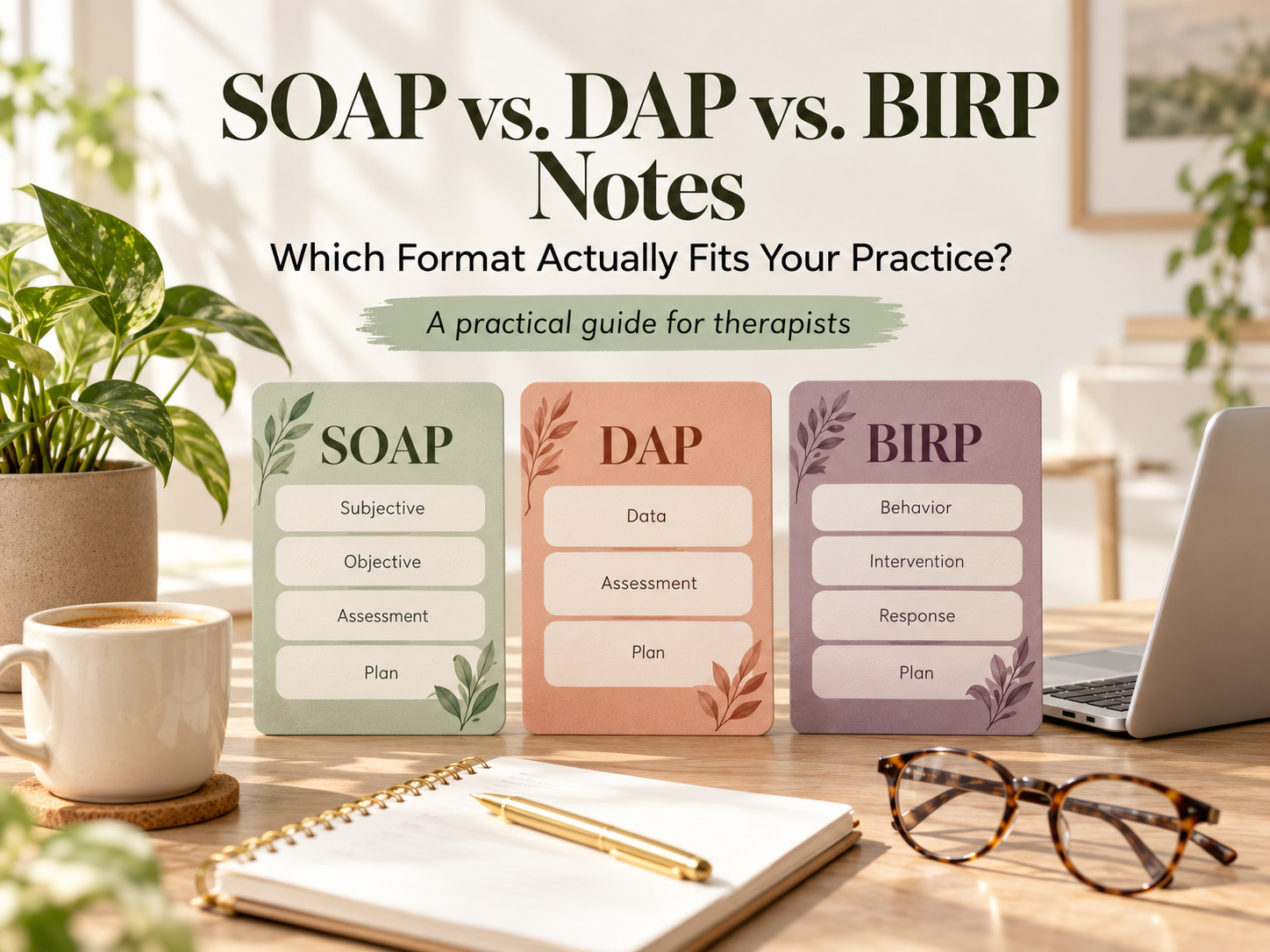
If you are also deciding how to structure session notes, see the guide to SOAP vs. DAP vs. BIRP notes.
Frequently asked questions about couples therapy treatment plans
What should be included in a couples therapy treatment plan?
A useful plan typically includes the presenting concerns, relevant relationship and individual context, treatment goals, objectives, interventions, a way to monitor progress, and a plan for reviewing or updating treatment. Your setting may require additional information.
What are common goals for couples therapy?
Common areas include communication, conflict management, emotional connection, trust, intimacy, co-parenting, problem-solving, boundaries, adjustment to life changes, and relationship decision-making. The goals should reflect the actual couple rather than a standard list.
How do you write measurable goals for couples counseling?
Start with the relationship change you want to see, then describe a behavior, skill, experience, or pattern that would indicate movement in that direction. Measurement may involve frequency, self-report, observed skill use, standardized measures, progress ratings, or another method appropriate to the goal.
Can both partners have different goals?
Yes. Partners often enter therapy with different priorities. Some goals may eventually become shared, while others may remain individual considerations that affect the relationship. When the differences are substantial, clarifying what each partner wants from therapy may itself become part of the early work.
How often should a couples therapy treatment plan be updated?
Follow any review schedule required by your employer, payer, or setting. Otherwise, update the plan when goals are met, priorities change, treatment stalls, new concerns emerge, or the existing plan no longer reflects the work you are doing.
Can couples treatment plans include individual mental health concerns?
They can when those concerns are relevant to the treatment. Be clear about how the individual factor relates to the relationship work, and follow the documentation requirements that apply to your setting and the service being provided.
Should intimate partner violence be treated as a couples communication problem?
No. Abuse and coercive control raise different safety and treatment considerations from ordinary relationship conflict. If there are concerns about abuse, intimidation, retaliation, or coercive control, assess and respond according to your training, professional responsibilities, local requirements, and the safety needs of the people involved.
Can I use a couples therapy treatment plan template?
Yes, when templates are appropriate for your setting. A template can help organize recurring information and reduce repetitive writing, but the final plan should reflect the individual couple, your assessment, your clinical decisions, and any requirements that apply to your work.
If you prefer an editable system rather than a static form, the Couples Therapy Documentation Toolkit includes a customizable Google Sheets treatment plan builder together with intake, session, and progress-note tools.
One final thought
A good couples treatment plan does not need to capture everything you know about the relationship.
It needs to give the work a direction.
What pattern are we trying to change? What would meaningful improvement look like? What are we doing to help the couple get there? And how will we know when something has shifted?
If the plan answers those questions clearly, it is already doing useful work.