A useful speech therapy SOAP note should show more than what you worked on. It should help another reader understand how the client performed, what support you provided, what you changed during the session, and what you plan to do next.
“Practiced /r/ sounds” tells very little on its own. A stronger note shows the level of practice, the client’s performance, the support that was needed, and how that information shaped your clinical decision.
Below is a practical breakdown of the SOAP note format for speech therapy, followed by examples for articulation, language, and fluency, common documentation mistakes, and a simple checklist you can use before signing a note.
If the repetitive part of writing SOAP notes is what slows you down, the Speech Therapy Toolkit includes customizable Google Sheets SOAP note builders for SLPs. I’ll show you how those tools fit into the documentation process later in the article.
Documentation requirements vary by setting, employer, payer, and jurisdiction. Use the structure and level of detail required for your own practice.
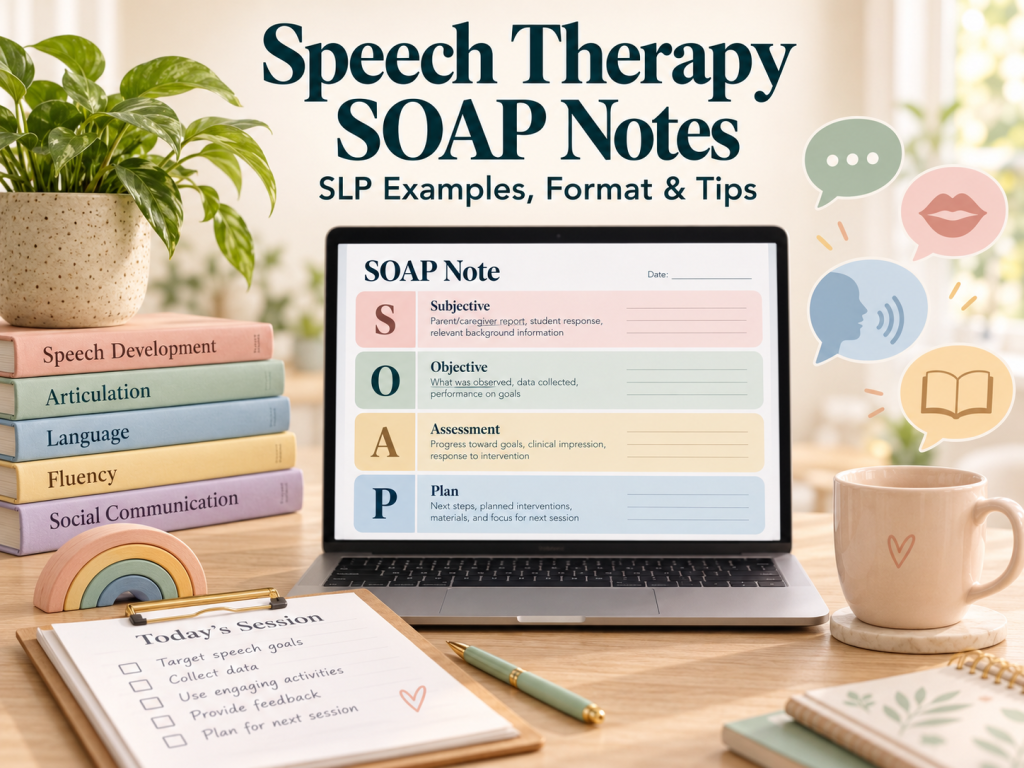
What goes in each section of a speech therapy SOAP note?
| Section | What belongs here | Example |
|---|---|---|
| S – Subjective | Relevant information reported by the client, parent, caregiver, teacher, or another appropriate source. | “Parent reports that Maya has started using longer phrases when asking for help at home.” |
| O – Objective | What happened during the session: measurable performance, level or context, cueing or assistance, and the skilled intervention you provided. | “Produced initial /r/ at phrase level in 16/20 opportunities with minimal visual and verbal cues.” |
| A – Assessment | Your clinical interpretation. What changed? What helped? What remains difficult? What does today’s performance suggest about progress or the next step? | “Accuracy increased compared with the previous session, with less cueing needed for tongue placement. Carryover to sentence-level production remains inconsistent.” |
| P – Plan | What happens next: changes in task complexity, cueing, home practice, caregiver education, treatment focus, or other relevant next steps. | “Continue phrase-level practice and introduce short sentences as appropriate. Fade visual cueing and continue home practice.” |
The Objective section: make the clinical work visible
The Objective section is where the details of the session become measurable.
You do not need to document every activity. Focus on the information that helps another reader understand what you targeted, how the client performed, what support was needed, and what you did in response.
Depending on the goal, useful details may include:
- Target: the speech sound, language structure, fluency strategy, communication behavior, swallowing skill, AAC skill, or other goal addressed.
- Level or context: isolation, word, phrase, sentence, structured conversation, spontaneous conversation, play, reading, classroom activity, or another relevant context.
- Performance: correct responses over total opportunities, accuracy, frequency, duration, latency, rating, or another measure appropriate to the goal.
- Support: modeling, verbal cues, visual cues, tactile cues, prompting, choices, repetitions, or other assistance.
- Skilled intervention: what you taught, modeled, analyzed, adjusted, or changed based on the client’s performance.
For example:
Less informative:
“Worked on /s/ blends. Client did well.”
More informative:
“Produced initial /s/ blends at phrase level in 17/20 opportunities. Accuracy improved with a slowed clinician model and visual cueing; cues were reduced during the final five trials.”
The second version gives the reader more than a score. It also shows what the SLP contributed to the session.
You do not need the same measurement for every goal
A percentage can be useful, but it is not automatically the best measure for every speech-language goal.
Depending on what you are targeting, you may find it more useful to record:
- correct responses out of total opportunities;
- frequency or duration;
- level of independence;
- amount or type of cueing;
- response latency;
- caregiver performance;
- functional use of the skill;
- or another measure that makes sense for that particular goal.
If you do use a percentage, add enough context to make it meaningful.
“80% accuracy” leaves questions.
“16/20 opportunities independently at word level” tells the reader much more.
The goal is not to make every session look identical. It is to make changes in performance understandable over time.
Keep cueing language consistent
Terms such as minimal, moderate, maximal, verbal, visual, tactile, direct model, and independent are most useful when you use them consistently.
Follow the terminology required by your employer, documentation system, or payer when one is specified. Otherwise, aim for wording that makes the client’s level of support clear from one session to the next.
This helps you see whether the client is becoming more independent, continuing to need the same amount of support, or responding better to a different approach.
If keeping track of performance, trials, cueing, and several goals in one session is the part that takes the most time, the Speech Therapy Toolkit includes an extended SOAP note generator that lets you document up to five goals separately. You can record the goal, performance, number of trials, cueing level, cue type, and generalization for each one, then review and edit the generated note before using it in your records.
Three speech therapy SOAP note examples
The examples below are fictional. They are meant to show how the SOAP structure can organize clinical information, not to provide required wording for every setting.
1. Articulation SOAP note example
S: Student reported practicing the home word list several times this week and stated that /r/ words “feel easier.”
O: Vocalic /r/ at word level: 18/20 opportunities produced accurately without clinician cueing. At sentence level, 14/20 opportunities were accurate with intermittent verbal cues for tongue positioning and self-monitoring. Student independently corrected 4 of 6 inaccurate productions after a pause and self-check prompt.
A: Word-level production remained strong during today’s session. Sentence-level accuracy increased compared with the previous session, and the student required less direct cueing for several productions. Independent self-monitoring is beginning to emerge, although carryover at sentence level remains inconsistent.
P: Continue sentence-level practice and introduce short structured reading tasks as appropriate. Shift from direct placement cues toward self-monitoring prompts. Continue home practice using individualized target words.
2. Preschool language SOAP note example
S: Parent reported hearing more two-word combinations at home, including “more juice” and “Daddy go.” Parent also reported that the child is attempting to imitate new action words during play.
O: During play-based language activities, child produced 12 spontaneous two-word combinations and 8 additional combinations following clinician modeling. Child labeled 7/10 targeted action words with picture support and 3/10 without visual support. SLP used modeling, expansion, repetition, and aided choices to support expressive language. Two brief movement breaks were incorporated when attention decreased.
A: Spontaneous two-word combinations were observed more frequently than at the beginning of treatment. Action-word retrieval continues to improve with visual support but remains more difficult without pictures. Brief movement breaks appeared to support re-engagement in language tasks.
P: Continue modeling and expansion during play. Introduce three additional functional action words and continue opportunities for spontaneous two-word combinations. Review expansion strategy with parent for home use.
3. Fluency SOAP note example
S: Adolescent reported feeling less anxious during a recent class presentation and rated speaking-related anxiety at 4/10 compared with 6/10 on a previous self-rating.
O: During structured practice, client used the targeted easy-onset strategy in 15/20 planned opportunities with intermittent verbal cueing. During a three-minute conversation sample, client independently identified 4/5 moments of increased physical tension. SLP provided modeling, guided practice, and discussion of when the strategy felt helpful versus effortful.
A: Client demonstrated greater awareness of physical tension and increased independence in identifying opportunities to use the practiced strategy. Client also reported lower speaking-related anxiety in a recent classroom situation. Continued work is indicated on flexible strategy use and carryover into personally relevant speaking situations.
P: Practice targeted strategies during role-play of classroom speaking situations. Discuss additional options for managing moments of tension and select one personally meaningful speaking situation to reflect on before the next session.
Fluency goals are highly individualized. This example reflects one possible treatment plan rather than a universal approach to fluency treatment.
Assessment should explain the data, not repeat it
This is one of the easiest places for SOAP notes to become repetitive.
If your Objective section says:
“Produced /k/ in 14/20 opportunities with moderate verbal and visual cueing,”
there is little value in writing this in Assessment:
“Client produced /k/ with 70% accuracy.”
The reader already knows that.
Assessment is where you explain what the performance means:
“Accuracy improved when visual placement cues were paired with a slowed model. Client continues to need support to maintain correct placement without a model, suggesting that independent production is not yet consistent.”
Now the reader can see the connection between the data and your clinical reasoning.
Weak vs. stronger speech therapy documentation
A note can include a score and still leave the reader unsure what skilled service the SLP provided.
ASHA’s guidance on skilled documentation emphasizes showing the clinician’s analysis, intervention, cueing or assistance, feedback, treatment modifications, and response to the client’s performance rather than recording performance alone.
| Less informative | More informative |
|---|---|
| Worked on /s/. Did well. | Produced initial /s/ at phrase level in 17/20 opportunities. Accuracy improved after visual cueing for tongue placement; cues were reduced during later trials. |
| Client was distracted. | Client required three redirections during the 30-minute session. Performance decreased during longer tabletop tasks and improved after the activity was shortened and visual supports were added. |
| Continue plan of care. | Continue sentence-level target practice and introduce structured reading as performance allows. Reduce direct cueing and increase opportunities for self-monitoring. |
| Parent was given homework. | SLP modeled the expansion strategy and coached parent during play. Parent demonstrated the strategy independently in three opportunities before the end of the session. |
| Patient tolerated treatment well. | Client completed all planned tasks. When fatigue increased during the final activity, SLP shortened task length and added written cues, which improved participation and response accuracy. |
For more detail on skilled documentation, see ASHA’s examples of skilled versus unskilled documentation.
Common speech therapy SOAP note mistakes
1. Reporting data without enough context
“80% accuracy” is difficult to interpret if the reader does not know the target, level, number of opportunities, or support provided.
Add the details that change the meaning of the data.
2. Listing the activity instead of the skilled service
“Played a language game” tells the reader what happened in the room.
It does not explain the clinical work.
When relevant, document what you targeted, how you supported the client, what you modified, and what happened as a result.
3. Copying the same note from session to session
Templates can save time. Repeating the same clinical content cannot.
If every Assessment and Plan looks almost identical, meaningful changes in the client’s performance can disappear.
4. Repeating Objective in Assessment
Objective: What happened?
Assessment: What does it mean?
Keeping those two questions separate is one of the simplest ways to make a SOAP note more useful.
5. Writing a Plan that never responds to the session
If the client is improving, struggling, generalizing, or becoming more independent, the plan may eventually need to change too.
That might mean increasing difficulty, reducing cueing, changing the context, modifying home practice, involving a caregiver differently, or continuing the same approach because it is still clinically appropriate.
6. Documenting cueing without showing what happened next
“Moderate verbal cues provided” can be useful information, but it becomes more meaningful when you show the effect.
For example:
“Client initially required direct verbal models. After five supported trials, clinician reduced support to a visual cue, with accurate production in 4/5 subsequent opportunities.”
7. Including detail simply because it happened
A progress note is not a transcript.
Before adding another sentence, ask:
Does this help explain the client’s performance, the skilled intervention, my clinical decision, or the next step?
If not, it may not need to be there.
A simple speech therapy SOAP note checklist
Before you finish a note, check whether another reader can quickly find the information that matters.
Subjective
- Did I include relevant information reported by the client, parent, caregiver, teacher, or another appropriate source?
- Did I keep my own clinical observations in the Objective section?
Objective
- Is the target clear?
- Did I identify the level or functional context when it matters?
- Is the client’s performance understandable?
- Did I document cueing, assistance, or independence when relevant?
- Can the reader see what skilled intervention I provided?
- Did I note important changes or modifications I made during the session?
Assessment
- Did I interpret the data rather than repeat it?
- Is progress, difficulty, or change understandable?
- Did I explain what helped or what continues to interfere with performance?
- Is the connection to the treatment goal clear when relevant?
Plan
- Does the Plan make sense based on today’s performance?
- Am I continuing, advancing, modifying, or fading support for a reason?
- Did I include relevant home practice, caregiver education, follow-up, or next-session focus?
Your setting may require additional information such as the service date, duration, delivery model, location, credentials, signatures, diagnosis, plan-of-care information, or other documentation elements.
How long should a speech therapy SOAP note be?
There is no useful universal word count.
A good note is long enough to explain the clinically relevant work and short enough that the important information is easy to find.
More detail is not automatically better.
A straightforward session may need only a few focused sentences in each section. A complex session, significant change in status, caregiver-training session, or major treatment modification may need more explanation.
Think specific rather than long.
Do speech therapists have to use SOAP notes?
No single documentation format applies to every SLP setting.
SOAP is commonly used in health care, but schools, clinics, hospitals, private practices, early-intervention programs, and other settings may use different formats and requirements.
ASHA does not prescribe one universal documentation format. If your employer, payer, EHR, state program, or another governing requirement specifies a structure, follow that requirement.
The format is the container. The more important question is whether the note clearly communicates the service provided, the client’s performance, your clinical reasoning, and the next step.
You can read more in ASHA’s documentation guidance.
Make speech therapy SOAP notes easier to return to
Knowing what belongs in a SOAP note is one thing. Writing it after a full day of sessions is another.
You may already know the goal you targeted, how the client performed, which cues helped, and what you want to work on next. The tiring part is often turning the same types of information into clear documentation again.
The Speech Therapy Toolkit was created to make that part of the process easier.
It includes four coordinated Google Sheets tools:
- Speech Therapy SOAP Note Template — an editable SOAP layout for structured documentation.
- Speech Therapy SOAP Note Generator — choose from customizable dropdowns or enter your own information, then review and edit the generated SOAP note.
- Extended Speech Therapy SOAP Note Generator — document up to five goals separately, including performance, number of trials, cueing level, cue type, and generalization.
- Speech Language Pathology Evaluation — organize referral information, case history, assessment results, speech and language findings, fluency, voice, feeding and swallowing information, clinical impressions, and recommendations.
The dropdown lists are editable, so you can change or expand the wording to suit your own caseload and documentation style. You can also type your own information whenever a dropdown option does not fit.
The generators bring your selected or typed information together into a SOAP note that you can review, edit, and copy into your documentation system.
The goal is not to make clinical decisions for you or turn every session into the same note.
The spreadsheet carries some of the structure. You still carry the clinical judgment.
Explore the Speech Therapy Toolkit →
You can also browse all speech therapy templates and documentation tools.
Frequently asked questions
What should I write in Assessment?
Assessment is your interpretation of the session. Rather than repeating the numbers from Objective, explain what the performance suggests about progress, remaining difficulty, response to intervention, functional change, or the direction of treatment.
Do I need a percentage for every speech therapy goal?
No. The most useful measure depends on the goal. Accuracy may work well for some targets, while frequency, duration, cueing, level of independence, response latency, functional performance, or another measure may be more meaningful for others.
Can I use a speech therapy SOAP note template?
Yes, if templates are appropriate for your setting. A template can reduce repetitive writing and help keep documentation organized, but the finished note still needs to reflect the individual client, the actual session, and your clinical decisions.
If you prefer an editable system rather than a fixed printable form, the Speech Therapy Toolkit includes both a structured SOAP note template and customizable Google Sheets note generators.
Can I document more than one goal in the same SOAP note?
Yes, when that reflects your session and documentation requirements. Make it clear which performance, cueing, and intervention information belongs to each goal so the reader can follow what happened.
The Extended Speech Therapy SOAP Note Generator included in the Speech Therapy Toolkit is designed to organize up to five goals separately within the same session.
One last thought
A useful SOAP note does not need to sound impressive.
It needs to make the clinical story easy to follow:
What did you target? How did the client perform? What did you do as the SLP? What did you learn from the response? And what happens next?
If those answers are clear, the note is already doing a lot of its job.
And if the hardest part is simply finding the words again at the end of the day, a structured tool can take some of that repetitive work off your plate.
See the Speech Therapy Toolkit →