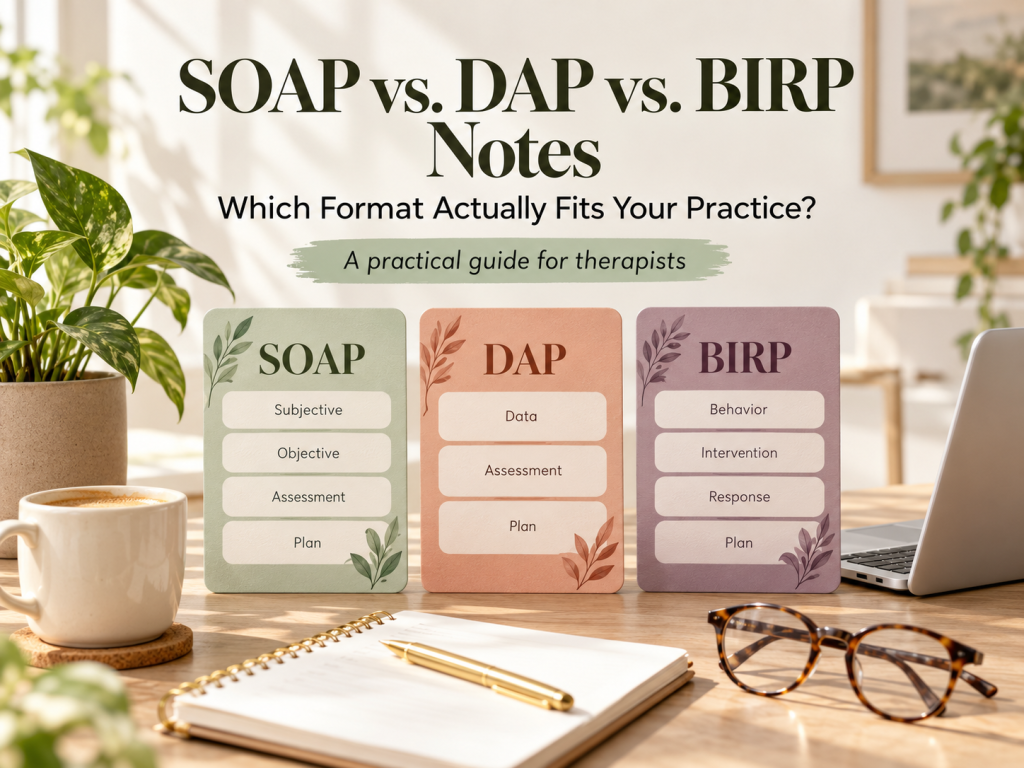
SOAP, DAP and BIRP can all document a therapy session well. The difference is not that one format is “correct” and the others are not. The difference is what each format makes easiest to see: SOAP gives clear separation between what the client reports, what you observe and what you conclude clinically. DAP keeps those pieces more compact. BIRP gives more space to the intervention you used and the way the client responded.
So before choosing a format, ask a more useful question:
What does someone need to understand quickly when they read my note?
Your answer may depend on your workplace, documentation system, payer requirements, supervision, client population and the kind of therapy you provide. This guide is meant to help you think through that choice. If your employer, EHR, payer or other governing requirement gives you a specific documentation structure, follow that requirement first.
SOAP, DAP or BIRP? A quick way to decide
| If you want your note to… | Consider | Why |
|---|---|---|
| Clearly separate the client’s report from your observations | SOAP | Subjective and Objective information have their own sections. |
| Show your clinical reasoning clearly | SOAP | Assessment has a dedicated place for your interpretation of the session. |
| Keep the note relatively compact | DAP | Reported information, observations and session data can stay together in one section. |
| Avoid forcing a separate Objective section when there is little to add | DAP | This can feel natural in talk therapy and telehealth, where observation may be limited. |
| Make the intervention you provided easy to find | BIRP | Intervention has its own section rather than being buried inside the session narrative. |
| Show how the client responded to your intervention | BIRP | Response is documented separately and can make the clinical sequence easier to follow. |
| Keep treatment goals highly visible from session to session | GIRP | GIRP begins with the goal addressed before moving into intervention, response and plan. |
There is no need to force your practice into a format simply because it is popular. A useful format is one that helps you document the required information clearly and consistently without making the note harder to write than it needs to be.
What matters more than the letters at the top of the note
You can write a beautifully organized SOAP note and still leave out something important. You can also write an excellent DAP or BIRP note if the clinically relevant information is there. Whatever structure you use, a reader should be able to understand the basic clinical story:
- What brought the client into this session?
- How are symptoms or concerns affecting functioning?
- What treatment goal or problem did you address?
- What did you do clinically?
- How did the client respond?
- Is the client improving, worsening or remaining relatively stable?
- Was there relevant risk or safety information?
- What happens next?
Your setting may require additional information such as the date, session duration, modality, diagnosis, provider credentials or other elements. Check the requirements that apply to your own documentation.
A helpful editing question: if another qualified clinician opened this record tomorrow, would the note make sense without me standing next to them explaining it? If the answer is yes, you are probably documenting the right level of information.
SOAP notes: useful when you want a clear line between “reported,” “observed” and “assessed”
Subjective · Objective · Assessment · Plan. SOAP gives each type of information its own home. That can be helpful when your clinical reasoning needs to be easy to follow.
| Section | What to include |
|---|---|
| Subjective | The client’s side of the session: symptoms, concerns, changes since the last visit, relevant experiences and the client’s own description of how they are doing. A short direct quote can be useful when the client’s wording adds something clinically meaningful. |
| Objective | What you directly observed or measured, such as appearance, affect, behavior, speech, participation or results from a measure used in the session. |
| Assessment | Where you make sense of the information rather than simply repeat it: symptom change, functioning, progress toward a treatment goal, barriers, clinical impressions or relevant risk. It answers: what does today’s information mean clinically? |
| Plan | What happens next: treatment focus, homework or practice, referrals, follow-up or other next steps relevant to the client’s care. |
One easy distinction: “Client reported sleeping better” is Subjective. “Client appeared less restless and spoke at a slower pace” is Objective.
Where SOAP works especially well
SOAP can be a good fit when you want your note to make the distinction between client report, clinician observation and clinical interpretation very clear. It can also be useful when notes are likely to be read by several professionals or reviewed in supervision, because the reader can quickly see where the information came from.
A common SOAP problem
The Objective section can become filler. If every note contains essentially the same sentence about appearance, orientation and cooperation, ask whether you are recording something clinically useful or simply filling the section because it exists. When there is something meaningful to observe, document it. When there is not much objective information, keep the section concise rather than inventing detail.
DAP notes: useful when you want less separation and a more compact flow
Data · Assessment · Plan. DAP removes the Subjective/Objective split. Instead, the relevant information from the session lives together in Data. For many therapists, this makes the note feel more natural because client report, observation and intervention often happen together in real clinical work.
| Section | What to include |
|---|---|
| Data | The information needed to understand the session: what the client reported, what you observed, relevant measures and the interventions you used. |
| Assessment | Your interpretation of the Data. What changed? What remains difficult? How is the client functioning? What progress or barriers are you seeing? Is there relevant risk? |
| Plan | The next clinical step: practice between sessions, treatment focus, referrals, follow-up or other relevant plans. |
The biggest trap is treating Data as a transcript. You do not need to record every topic discussed. A useful filter: do I need this detail to understand my assessment, the intervention or the next step? If not, it may not need to be in the note.
Where DAP can be especially comfortable
DAP can work well when a separate Objective section feels artificial or repetitive. For example, in telehealth or primarily verbal psychotherapy, reported and observed information may fit naturally together rather than being separated into two short sections.
A common DAP problem
Because everything is combined in Data, it is easy for the clinical work to disappear inside a paragraph of session content. Make sure the reader can still find the clinically relevant information, the intervention you used and what you concluded from the session.
BIRP notes: useful when you want the clinical work to be easy to see
Behavior · Intervention · Response · Plan. BIRP makes one part of documentation particularly clear: the relationship between what you did and what happened next.
| Section | What to include |
|---|---|
| Behavior | The clinically relevant presentation at the beginning of or during the session: the client’s concerns, symptoms, behavior, functioning or other information that explains what was being addressed. |
| Intervention | What you actually did as the clinician. Specific language is usually more useful than general language. |
| Response | What happened after the intervention. Go a little further than “client was receptive”: receptive to what? What did the client understand, practice, say or do? |
| Plan | The next step: continued work on the goal, skills practice, homework, follow-up, referral or other relevant plans. |
Less useful: “Provided support.”
More useful: “Used cognitive restructuring to examine the client’s prediction that she would freeze during the presentation.” The second sentence tells the reader what the therapeutic work actually involved.
A useful Response section might show that the client:
- identified a pattern
- practiced a skill
- generated an alternative thought
- became more engaged
- reported reduced distress
- remained uncertain, needed prompting or did not respond as expected
Where BIRP can be especially useful
BIRP may feel natural when your work includes identifiable techniques, skills or structured interventions, because it keeps the intervention-response sequence visible. If your work is highly exploratory or relational, you may find that another structure fits your documentation style more comfortably.
The same session written three ways
Scenario: a fictional 55-minute telehealth session with an adult client being treated for generalized anxiety. The client reports increased worry about an upcoming work presentation, several nights of poor sleep and difficulty concentrating.
SOAP
- S: Client reported increased worry about a work presentation on Friday and difficulty falling asleep on three nights this week. Stated, “I keep thinking I’ll freeze and everyone will see I’m not good enough.” Denied thoughts of self-harm.
- O: Telehealth session, 10:00–10:55. Client appeared tense, spoke rapidly and frequently touched her face. Affect appeared anxious and consistent with reported mood. GAD-7 score: 14; previous score: 11.
- A: Client reports increased anxiety related to an upcoming work stressor, with current impact on sleep and concentration. Client identified catastrophic predictions with prompting and showed partial progress toward the treatment goal of identifying and challenging anxious thoughts. No current safety concerns identified during the session.
- P: Continue current CBT work. Client will complete a thought record before the presentation and practice paced breathing in the evening. Review experience and homework next session.
DAP
- D: Telehealth session, 10:00–10:55. Client reported increased worry about Friday’s work presentation and difficulty sleeping on three nights this week. Client appeared tense and spoke rapidly. GAD-7 score increased from 11 to 14. Session included cognitive restructuring and paced-breathing practice. Client denied thoughts of self-harm.
- A: Anxiety has increased in connection with the upcoming presentation and is affecting sleep and concentration. Client identified catastrophic thoughts with prompting and demonstrated partial progress toward the current treatment goal. No current safety concerns identified during the session.
- P: Client will complete a thought record before the presentation and practice paced breathing in the evening. Review homework and presentation experience next session.
BIRP
- B: Client presented as tense and anxious during a 10:00–10:55 telehealth session and reported increased worry about Friday’s work presentation, poor sleep and difficulty concentrating. GAD-7 score increased from 11 to 14. Client denied thoughts of self-harm.
- I: Used cognitive restructuring to examine the prediction, “I’ll freeze and everyone will see I’m not good enough.” Introduced and practiced paced breathing.
- R: Client identified two catastrophic thoughts and developed one more balanced alternative with prompting. Client completed paced-breathing practice and rated anxiety 7/10 before the exercise and 5/10 afterward.
- P: Client will complete a thought record before the presentation and practice paced breathing in the evening. Review practice and presentation experience next session.
What actually changed?
Very little about the clinical content changed. The format changed what became easiest to notice:
- In SOAP, you can quickly trace the path from client report to observation to clinical assessment.
- In DAP, the same session becomes more compact because the reported and observed information stays together.
- In BIRP, the intervention and the client’s response become much more visible.
That is a better way to think about these formats than asking which one is universally “best.”
A few situations that deserve extra thought
| Situation | What to consider |
|---|---|
| Telehealth | Document telehealth according to the requirements that apply to your practice. From a writing standpoint, some therapists find DAP comfortable for telehealth because reported and observed information can live together instead of requiring a separate Objective section when there is little new to observe. |
| Couples and family work | Keep the note focused on the treatment being provided and the clinically relevant relational patterns. Avoid turning the progress note into a detailed record of every disagreement or deciding which person was “right.” |
| Group therapy | Group documentation often needs to distinguish between what happened at the group level and how an individual member participated or responded. A structure that keeps intervention and response visible can make that easier, but use the format required by your program or organization when one is specified. |
| Different formats for different clients | You may encounter more than one format across different jobs, programs or client populations. If you are considering changing formats within your own practice, think first about consistency: a record is easier to follow when its organization does not change unnecessarily from one session to the next. |
If couples work is a significant part of your practice, you may prefer a structure designed specifically for relational documentation. The Couples Counseling Documentation Toolkit is one option.
Other formats you may come across
SOAP, DAP and BIRP are not the only options:
- GIRP (Goal, Intervention, Response, Plan) puts the treatment goal at the beginning of the note.
- PIRP uses Problem, Intervention, Response and Plan.
- You may also see variations such as SIRP or DARP.
The names change, but the underlying job of the note stays similar: organize clinically relevant information in a way that another reader can understand.
Three questions to ask before choosing a format
If you are still undecided, forget the acronyms for a moment and ask yourself:
- Who is likely to read this note?
- What do they need to find quickly?
- Which structure helps me document that information clearly without writing more than necessary?
Then make sure the format also fits any documentation requirements that apply to your setting.
When the format is not the real problem
Sometimes the frustrating part of progress notes is not deciding between SOAP, DAP and BIRP. It is getting to the end of a long day and having to find the words again. You know what happened clinically. You know which intervention you used. You know how the client responded. But turning the same kinds of information into clear documentation over and over still takes energy.
If that is the part you are trying to make easier, the SOAP, DAP and BIRP Progress Notes Bundle includes customizable Google Sheets builders for all three formats. You can select relevant wording from editable dropdown menus for areas such as presentation, intervention, response and plan, then review and adjust the resulting note before adding it to your record. The spreadsheet does not make the clinical decision for you. It simply gives you a structured starting point so you do not have to rebuild the wording from scratch every time.
You can also browse the full collection of therapy documentation tools, covering different parts of the workflow from intake through discharge.
Frequently asked questions
Do insurance companies require SOAP notes?
Not always. Some organizations, EHRs or payer contracts specify a documentation structure, while others focus on what the record contains. Check the requirements for the services you provide rather than assuming SOAP is required everywhere.
Can DAP be used for insurance documentation?
It can, when it meets the requirements of your setting and payer. DAP organizes the same clinical information as other formats; it just does not replace any required documentation elements.
What is the difference between BIRP and GIRP?
BIRP starts with the client’s behavior or presentation. GIRP starts with the treatment goal. The rest is the same: intervention, response and plan.
Which format is the fastest to write?
DAP is usually the most compact because report and observation share one section. In practice, the fastest format is the one you know well and can complete consistently without leaving out what you need.